" height="23.6250002861023px" id="jAEHRMpHQ" width="106.49999542236327px"/><path d="M 4.125 5.775 L 4.125 13.125 L 0 13.125 L 0 0.225 L 4.05 0.225 L 4.05 2.625 L 4.125 2.625 C 4.425 1.8 4.875 1.2 5.55 0.75 C 6.225 0.3 6.975 0.075 7.95 0.075 C 8.925 0.075 9.675 0.3 10.35 0.675 C 11.025 1.05 11.55 1.65 11.925 2.4 C 12.3 3.15 12.45 3.975 12.45 4.95 L 12.45 9.075 L 12.45 13.2 L 8.325 13.2 L 8.325 9.487 L 8.325 5.775 C 8.325 5.025 8.175 4.5 7.8 4.125 C 7.425 3.75 6.9 3.525 6.3 3.525 C 5.7 3.525 5.475 3.6 5.175 3.825 C 4.875 4.05 4.575 4.275 4.425 4.65 C 4.275 5.025 4.125 5.4 4.125 5.925 Z M 21 13.425 C 19.65 13.425 18.45 13.125 17.475 12.6 C 16.5 12.075 15.75 11.325 15.225 10.275 C 14.7 9.3 14.475 8.1 14.475 6.675 C 14.475 5.25 14.775 4.2 15.3 3.15 C 15.825 2.175 16.575 1.35 17.55 0.825 C 18.525 0.3 19.65 0 20.925 0 C 22.2 0 22.725 0.15 23.475 0.45 C 24.225 0.75 24.9 1.2 25.5 1.725 C 26.025 2.25 26.475 3 26.775 3.825 C 27.075 4.65 27.225 5.625 27.225 6.675 L 27.225 7.725 L 15.975 7.725 L 15.975 5.325 L 25.275 5.325 L 23.325 5.85 C 23.325 5.25 23.25 4.725 23.025 4.35 C 22.875 3.9 22.575 3.6 22.2 3.375 C 21.825 3.15 21.45 3 20.925 3 C 20.4 3 19.95 3.15 19.65 3.375 C 19.275 3.6 19.05 3.9 18.825 4.35 C 18.675 4.8 18.525 5.25 18.525 5.85 L 18.525 7.575 C 18.525 8.175 18.6 8.7 18.825 9.15 C 19.05 9.6 19.35 9.9 19.725 10.2 C 20.1 10.425 20.55 10.575 21.075 10.575 C 21.6 10.575 21.75 10.575 22.05 10.425 C 22.35 10.35 22.575 10.2 22.8 9.975 C 23.025 9.75 23.175 9.525 23.25 9.225 L 27 9.225 C 26.85 10.2 26.475 10.95 25.95 11.55 C 25.425 12.15 24.75 12.675 23.85 12.975 C 23.025 13.35 21.975 13.5 20.85 13.5 Z M 41.175 0.225 L 36.75 13.2 L 32.025 13.2 L 27.6 0.225 L 31.95 0.225 L 34.35 9.15 L 34.5 9.15 L 36.9 0.225 Z" fill="rgb(149, 156, 171)" height="13.5px" id="h0m7_Ax4m" transform="translate(108.75 5.625)" width="41.17499847412111px"/></g></svg>)
The Client
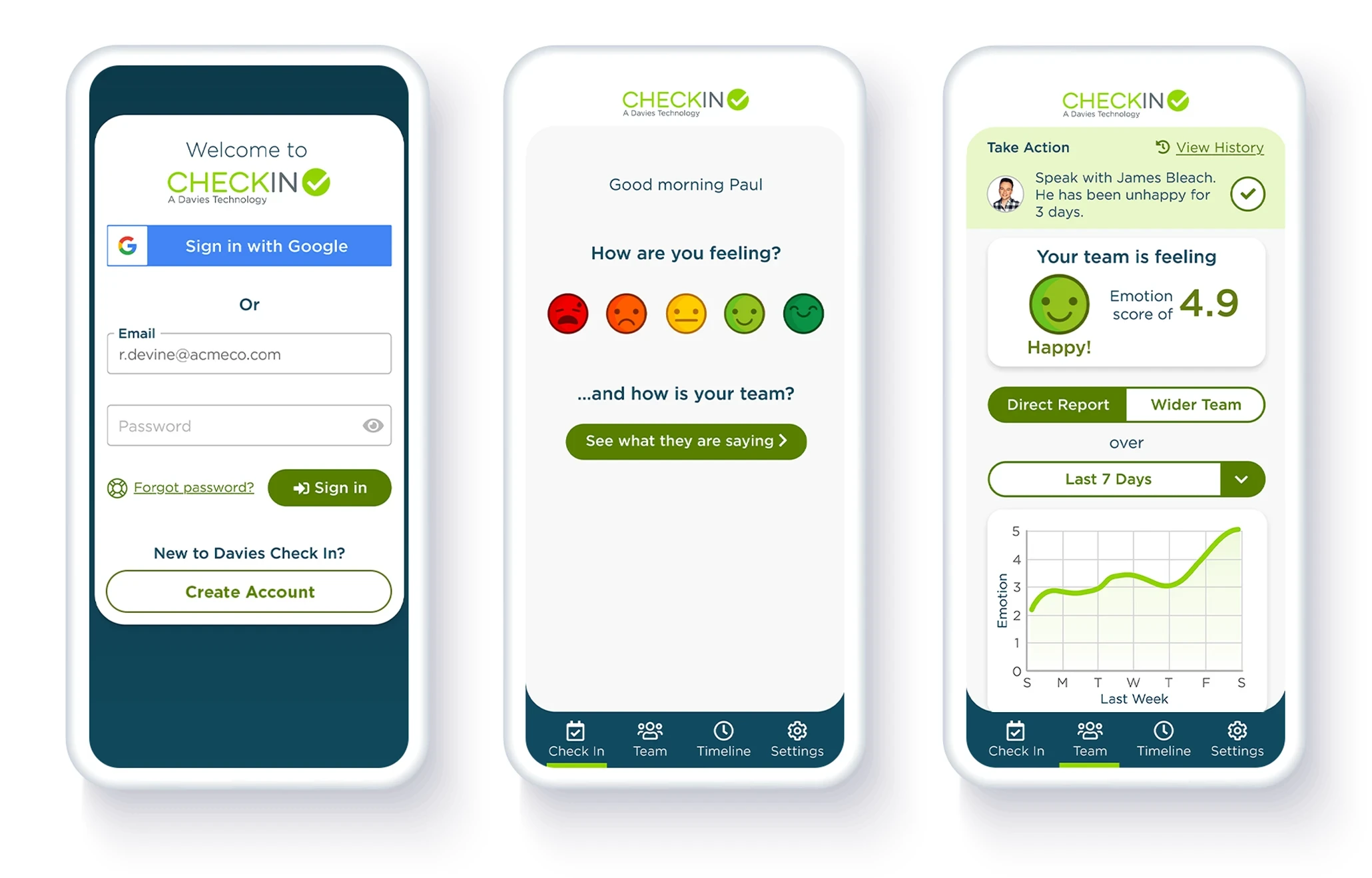
Check-In is an innovative employee wellness and mood-tracking application developed under the specialised expertise of Davies, a leading UK-based professional services organisation. While initiated internally to support their own workforce during unique challenges, the project was conceptualised and designed from the ground up as a robust technological product. The ultimate objective was to create a solution that could be made available to other employers, allowing them to proactively understand, track, and support the mental well-being of their own employees.
The Ask
As lockdown measures came into effect and the vast majority of Davies’ UK colleagues moved to remote working, an immediate and critical challenge emerged:
How could the organisation maintain a genuine pulse on employee well-being, understand how colleagues were truly coping in isolation, and provide effective support on a large, dispersed scale?
The goal was to move beyond traditional methods, which were proving inadequate in the new digital environment. The brief required the conceptualisation and creation of a dedicated, compassionate, and unobtrusive digital application. This tool needed to empower employees to easily express their mood, identify patterns in their well-being, and access appropriate support, while simultaneously providing managers and employers with anonymised, aggregated insights to understand team and organisational health.
What I Did
As the lead Product Designer (UI/UX) for this initiative, I architected the design journey from initial discovery to high-fidelity implementation, ensuring every decision was rooted in empathy, simplicity, and compassion.
Discovery & Synthesis (Research): My first step was deep research. I facilitated interactive workshops with Davies' internal Voice of the Employee (VOE) experts and executed comprehensive surveys involving employees from across the organisation. This enabled me to:
Identify core pain points: Isolation, anxiety about the future, stress of combining work/home life, and reluctance to articulate struggles through formal channels.
Uncover user needs: A quick, un-intimidating way to 'check-in'; access to varied resources; privacy and optional anonymity; non-judgmental tracking.
Understand constraints: Time-poor, often stressed users; the need to be unobtrusive and not feel like an additional task.
UX Foundations (Personas & User Journeys): I synthesised these insights to create detailed user personas (e.g., Sarah, experiencing remote work burnout; David, needing better team visibility as a manager). I then mapped out frictionless, compassionate user journeys for both employees and management, ensuring intuitive navigation and minimal effort at every touchpoint.
Ideation & Compassionate Design (Wireframing): I developed iterative low-fidelity wireframes, focusing on a reassuring visual language. Key design decisions included:
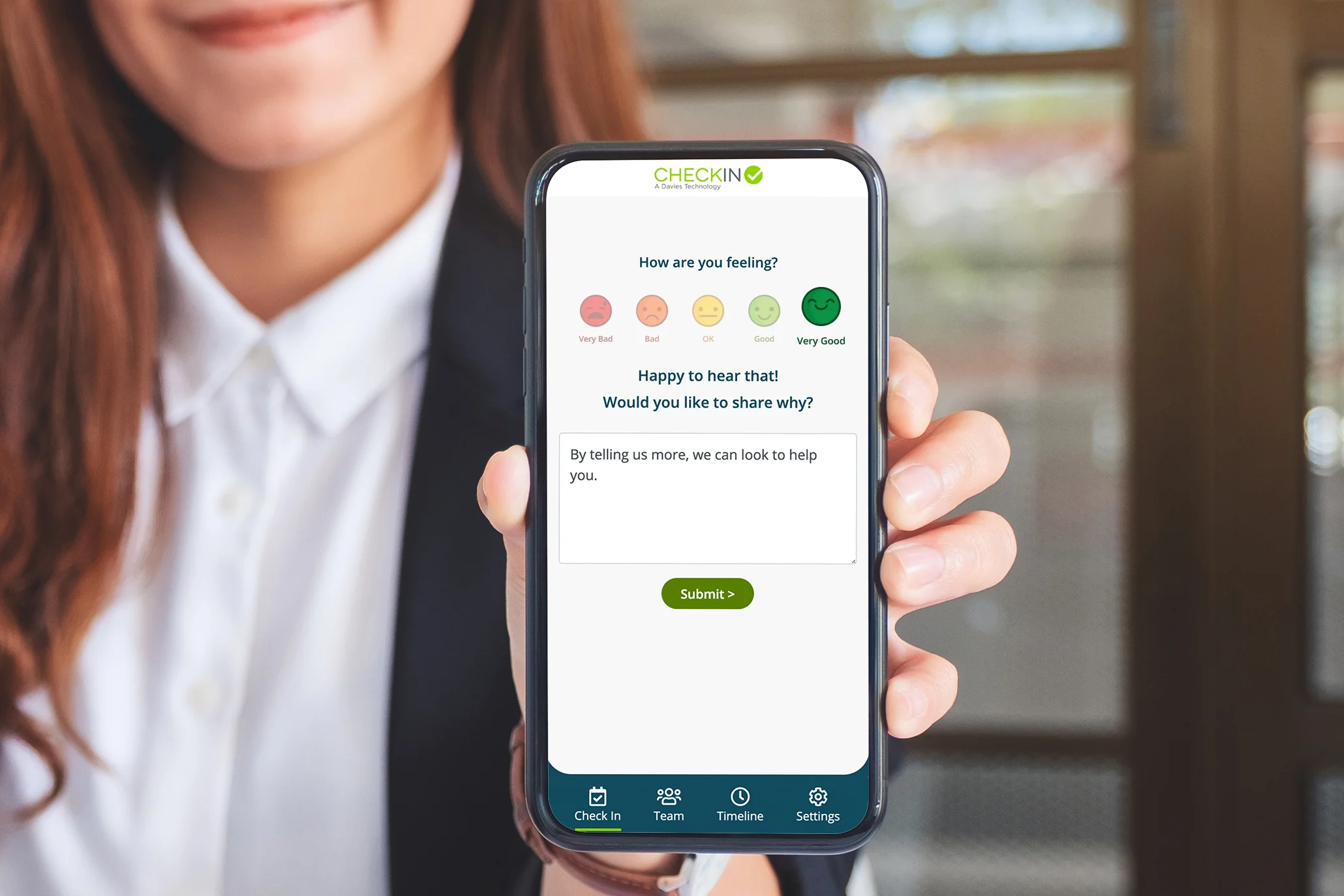
Intuitive mood tracking: Utilising specialised, colour-coded mood indicators and simple, relatable language to make checking in feel natural, not clinical.
Progressive disclosure: Presenting options (like adding notes or accessing resources) without overwhelming the user initially.
Emphasis on compassion: Designing interfaces that felt supportive and understanding, not purely transactional.
Iterative Refinement (Prototyping & UX/UI Reviews): I translated the wireframes into interactive prototypes. These underwent multiple rigorous UX/UI reviews with key stakeholders, including HR, VOE experts, and a representative group of potential users. This iterative process allowed me to:
Optimise flow: Refining user interactions to be as quick and unobtrusive as possible, minimising friction and maximising regular, stress-free engagement.
Test for compassion: Gathering qualitative feedback on the overall tone and visual compassion of the design.
Ensure visual accessibility: Applying appropriate contrast, font sizes, and localisation throughout.
Finalisation & Visual Identity (High-Fidelity UI): The culminating phase involved creating a polished, high-fidelity visual design for the Check-In app. I developed a warm, positive colour palette, soft edges, relatable imagery (avoiding typical corporate stock photos where possible), and a consistent visual hierarchy that optimised readability and prioritised supportive functionality.
The Result
I delivered a fully designed, human-centric application that fundamentally transformed Davies' approach to employee well-being and created a scalable, commercially viable product for other employers.
The final Check-In app successfully:
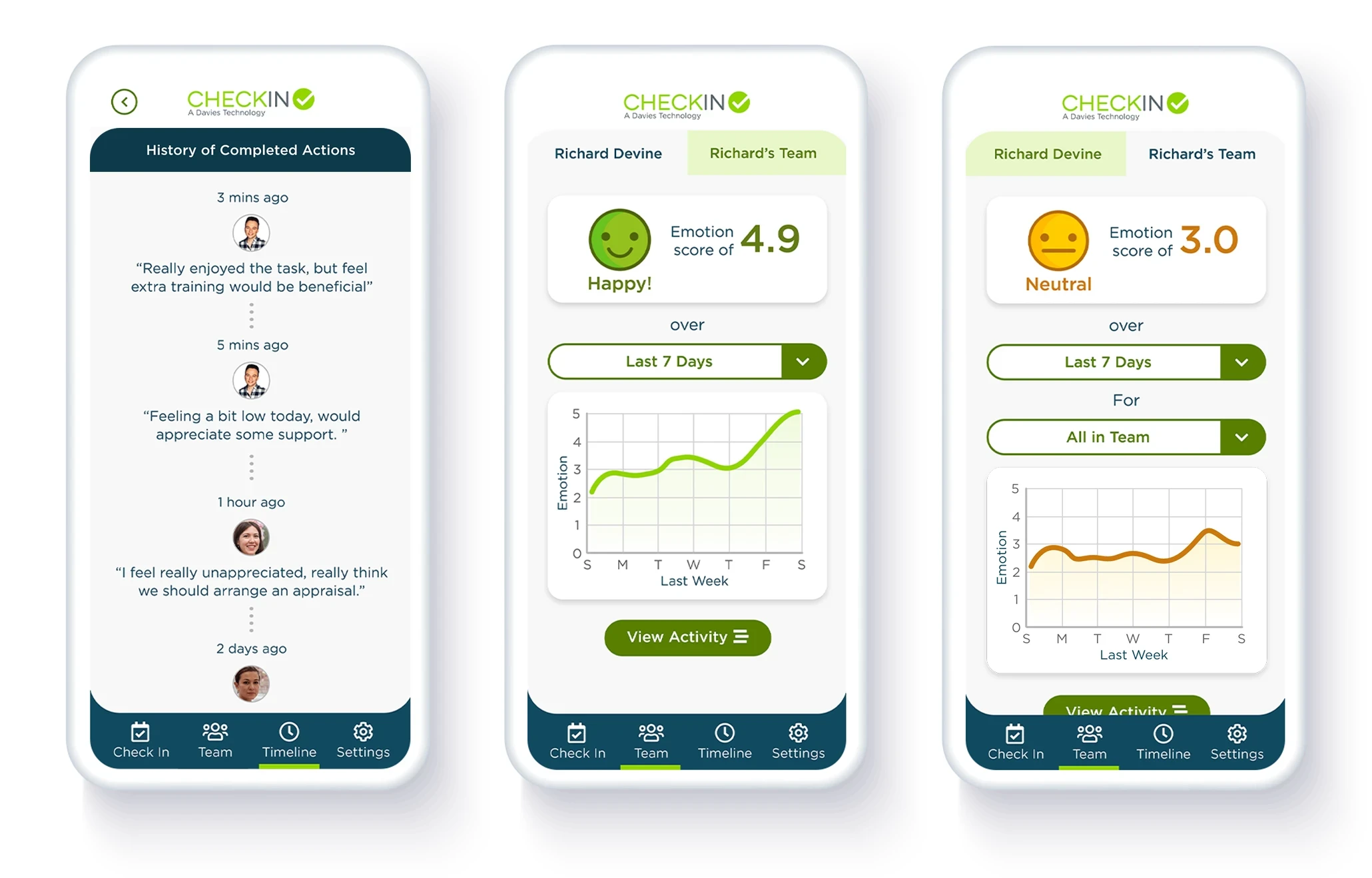
Humanised Employee Well-being Tracking: By making mood-tracking quick, relatable, and compassionate, the app successfully encouraged regular user check-ins, moving far beyond traditional, infrequent surveys.
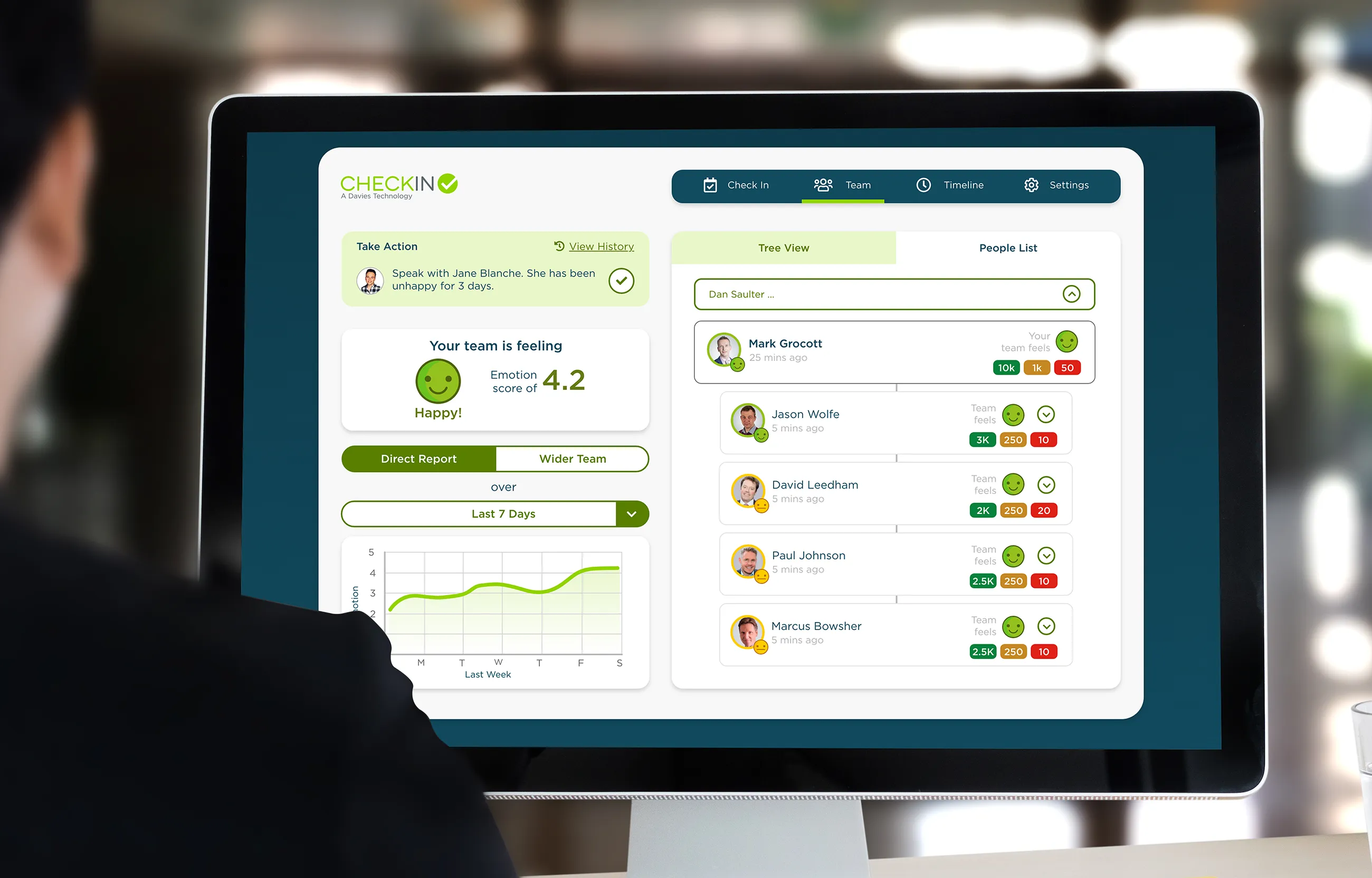
Empowered Earlier Intervention: With the ability for employees to view their mood patterns over time and for managers to see aggregated team data, the app provided vital insights that facilitated earlier support and conversation.
Positioned Davies as Progressive: Developing Check-In showcased Davies as an organisation that prioritises employee well-being not just in principle, but with innovative technological solutions, positioning them as an industry leader in specialised UK professional services.
Created a Market-Ready Product: The final high-fidelity design provided a consistent, robust visual and user experience that was fully prepared for software development and potential external licensing, demonstrating the conversion of an internal challenge into a successful digital product for broader application.
+72%
Increase in regular employee feedback
+63%
Employee adoption rate
+77%
Users found it helped them during pandemic